
-
- Notice
- No new notifications
-
- Messages
- See all notifications
-
18
- The cart
In the basket 0
in the amount of 0 RUB
- Go to basket
Vegetable seeds Flower seeds Grapes (plants) Mushrooms Agrochemicals
|
|
|
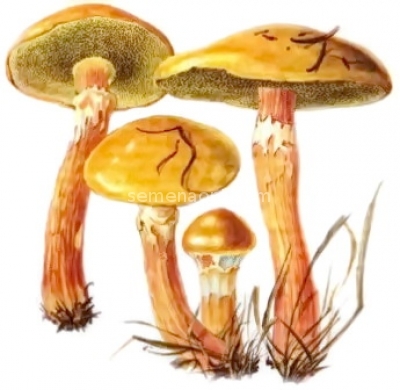
Greasers larch is the most frequent type of oil . It differs lemon-yellow hats and sponges, as well as the fact that always grows under larch . Peel hats, as well as at Other oils, slippery and easy to remove. greasers larch grows from June to November, under different types ofEuropean, Asian and American larch . Fruiting bodies usually appear in large numbers on the needles or in the grass and always within the root system of the tree . At certain places, this fungus can regularly collect tens of years . However, when a tree dies, gradually and it disappears. Greasers larch grows in the woods, where there islarch, from the lowlands to the mountains . It usually appears in some parks and gardens planted there by local and exotic species of larch . This species is widespread in the world: it grows abundantly in Europe, North America and North Africa, Japan, Australia, New Zealand . It was recorded in South America . This is an excellent edible mushroom,suitable for any cooking . Before preparing the slippery skin is recommended to remove . Greasers larch (Suillus grevillei) hat is slippery diameter of 4 - 15 cm, semi-circular, then flat, lemon yellow or yellow-gold color . The edges of the tubules also lemon-yellow, long closed are yellowish-white veil .
Want to buy the product? Leave a request.
There is a product? Sell on website.
| Requests SPECIFICATIONS Where to buy? | |
|---|---|
| Bag | |
| The size of the dispute | 7 - 10 x 3 - 4 pm |
| Disputes | yellowish fusiform |
| Description | |
| Name in latin | Suillus grevillei (KLOTZSCH) sing . |
| Storage | use fresh, reserve dried, pickled |
| Features | other than edible mushroom, suitable for any cooking |
| Fruiting bodies are formed (grows) | July - October |
| Edible | edible |
| Distribution | commonlycommon in the world: it grows abundantly in Europe, North America and North Africa, Japan, Australia, New Zealand . It was recorded in South America , |
| Taste | as a finished product - good |
| Grow | in forests where there is larch, from the lowlands to the mountains . It usually appears in some parks and gardens planted there by local and exotic species of larch |
| Smell | as a finished product - good |
| Fruiting body (Cap) | |
| Tubes | edge tubes also lemon-yellow, long are closed yellowish-white veil |
| Surface | slippery |
| Color | lemon yellow or yellow-gold color |
| Diameter | 4 - 15 cm , |
| Form | semi-circular,then flat |
| Plant | |
| Spore print | yellowish-brown |
| Flesh | yellow when cut in air cap slightly turns pink in the leg a little greens |
| Features | ring white, yellowish, rapidly disappearing |
| Stipe | |
| Diameter | I-2 (3) cm |
| Length | 4 - 10 (12) cm |
| Color | the ring is yellow, brownish below |
| Features | dense, with a ring |
Enter your information
To recover the password
Forgot password? Enter your e-mail
Registration for new users
Enter your details: