
-
- Notice
- No new notifications
-
- Messages
- See all notifications
-
18
- The cart
In the basket 0
in the amount of 0 RUB
- Go to basket
Vegetable seeds Flower seeds Grapes (plants) Mushrooms Agrochemicals
|
|
|
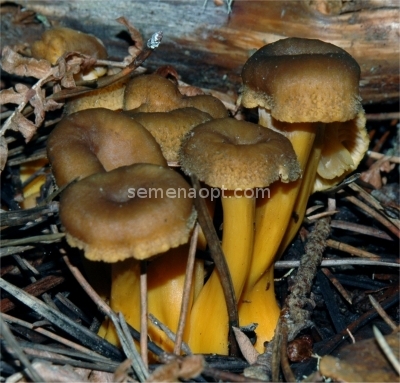
Chanterelle funnel (C . tubaeformis) grows most often in the autumn coniferousforests, together with related species: C . lutescens, different tan hat and plates with orange flavor, and C . in- fundibuliformis with dark brown hat and yellow leg . All of these types of mushrooms are edible . Hymenophore: spore-bearing layer chanterelles trubkovidnoy is a "false records," looking like an extensive network of threadlikenodules on the leaves folds, coming down from the inside of the cap to the leg . color - light gray, low-key . Spore print: Bright, greyish or yellowish . Leg: Height 3 - 6 cm, thickness 0.3 - 0.8 cm, cylindrical, blending smoothly into the hat, yellow or light brown, hollow . Distribution: The fungus belongs to the normal,but comes across in our area is not so often . What is the reason, in general it inconspicuous, or indeed Cantharellus tubaeformis becomes rare, hard to say . The idea is that trubkovidnaya fox forms Hymenophore with pine trees (simply, spruce) in damp mossy forests, where large groups and fruits in September and early October . Similar species: Celebrating also yellowing fox, Cantharellus lutesens, which, unlike chanterelles Cantharellus, devoid even of false records, shining almost smooth Hymenophore . On the other chanterelles trubkovidnuyu confused even more difficult . Edibility: Equals to the present chanterelle, Cantharellus cibarius, although the grocery store hardly bring muchjoy and esthete will not soon get bored to the same extent . Like all chanterelles, used mainly in fresh form, does not require preparatory procedures like boiling, and, according to writers, not full of worms . has a dark tan hat diameter of 4 - 6 cm. the gray-yellow plates . Dimensions legs 6.3 / 0.4 - 1see, the color yellow . Taste and smell expressionless. Spore print white . The debate (9) colorless with fine-grained content, sizes 8-11 / 5.5 - 8 PM . The flesh of all three species depicted yellowish .
| SPECIFICATIONS | |
|---|---|
| Bag | |
| Form dispute | elliptical |
| The size of the dispute | 11.8 / 5.5 - 8 mm |
| Description | |
| Name in latin | Cantharellus tubaeformis |
| Rod | fox |
| Storage | used mainly in fresh form, does not require preparatory procedures such as boiling |
| Features | form mycorrhiza mainly with conifers, rarely deciduous . Found shady forests on acid soils, can grow among the damp moss or rotting wood |
| Fruiting bodies are formed (grows) | September - earlywinter |
| Class | Agaricomycetes |
| Edible | edible mushroom |
| Distribution | in the northern temperate zone |
| Related species | yellowing chanterelle (Cantharellus lutescens) has a less developedfolded hymenophore, slightly protruding. Voronochnik gray (Craterellus cornucopioides) always has a dull, darker color, it has a sleek Hymenophore |
| Taste | weakly expressed, mild, sometimes bitter |
| Smell | weak, pleasant, it is compared with the smell of Mirabell, or earthy |
| Fruiting body (Cap) | |
| Surface | with fine velvety dark scales |
| Color | has a dark tan hat |
| Diameter | 4 - 6 cm |
| Form | in the form close to a hat-pediculo has a tubular structure with a funnel-shaped upper part ("hat ") |
| Plant | |
| Spore print | light, greyish or yellowish |
| Flesh | thin and thick, elastic consistency, white |
| Plates | yellow-gray |
| Features | fruits in large groups can form rows and rings , |
| Stipe | |
| Diameter | 0.3 - 0.8 cm |
| Length | 3 - 6 cm |
| Color | yellow or light brown, hollow |
| Features | cylindrical, blending smoothly into the bonnet |
Enter your information
To recover the password
Forgot password? Enter your e-mail
Registration for new users
Enter your details: