
-
- Notice
- No new notifications
-
- Messages
- See all notifications
-
18
- The cart
In the basket 0
in the amount of 0 RUB
- Go to basket
Vegetable seeds Flower seeds Grapes (plants) Mushrooms Agrochemicals
|
|
|
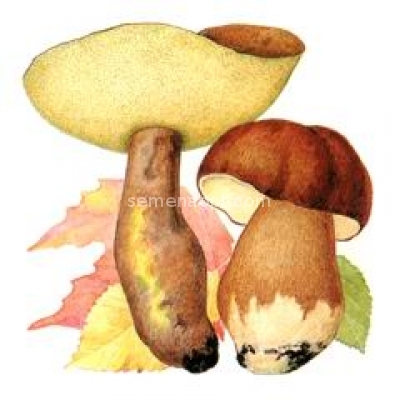
Chestnut fungus belongs to the rather rare, and not everyone lucky enough to find it . Caps 5 - 10 cm in diameter, inyoung specimens hemispherical and finely-velvety, then to cushion disclosed, dry, bare, dark-brown or chestnut-brown . pores initially whitish, later yellowish, sinuous, form a kind of labyrinth . Leg brown, brittle, within a hollow chamber, 5 - 9 cm long and 1.5 - 3 cm thick . The flesh is white . Spores almostcolorless, smooth, in the form of short cylinders, measuring 8 - 10 x 5 - 6 m . Uncommon or even rare and autumn (August - October) usually solitary in deciduous and mixed forests (mainly under oaks) occasionally also in coniferous forests . Edible . Chestnut mushroom quite similar to the edible bolete (Xerocomus badius), but itright, round, small pores, which, like the flesh, slightly turn blue when touched and filled foot .
| SPECIFICATIONS | |
|---|---|
| Bag | |
| Form dispute | in the form of short cylinders, oval |
| The size of the dispute | 8 - 10 x 5 - 6m |
| Disputes | colorless, smooth |
| Description | |
| Name in latin | Gyroporus castaneus (Bull . : Fr . ) Quel . Syn . : Boletus castaneus Bull: Fr . |
| Rod | Boletinus |
| Storage | basically suitable for drying in which the bitterness disappears . Do not like the poisonous mushrooms |
| Features | very rare mushroom |
| Fruiting bodies are formed (grows) | autumn (August - October) |
| Class | Agaricomycetes |
| Edible | edible mushroom |
| Distribution | in more southern areas of the northern temperate zone, from France to the Far East, everywhere is rare . In Russia - the southern European part, the Caucasus, Western Siberia and the Far East . view included in the Red Book of Russia |
| Related species | with edible bolete (Xerocomus badius), but that right, round,small pores, which, like the flesh, slightly turn blue when touched and filled leg |
| Taste | when cooking can acquire a bitter taste |
| Grow | in deciduous and mixed forests (mainly under oaks) occasionally also in coniferous forests |
| Fruiting body (Cap) | |
| Tubes | short (0.8 cm), free, first (the young fungus) white Older - creamy-yellow , with pressure on them remainbrown spots |
| Surface | dry, bare, thin-velvety |
| Color | dark-brown or chestnut-brown |
| Diameter | 5 - 10 cm |
| Form | in young specimens hemispherical, then to cushion disclosed |
| Features | pores first whitish, later yellowish, sinuous, form a kind of labyrinth |
| Plant | |
| Spore print | yellow |
| Flesh | white coloring on the fracture does not change, has a faint odor and taste of hazelnut |
| Features | hat can be of different colors - from light brown ororange-brown to reddish-brown |
| Stipe | |
| Diameter | 1.5 - 3 cm |
| Length | 5 - 9 cm |
| Color | brown |
| Features | cylindrical or slightly thickened at the base, fragile, inside hollow chamber |
Enter your information
To recover the password
Forgot password? Enter your e-mail
Registration for new users
Enter your details: