
-
- Notice
- No new notifications
-
- Messages
- See all notifications
-
18
- The cart
In the basket 0
in the amount of 0 RUB
- Go to basket
Vegetable seeds Flower seeds Grapes (plants) Mushrooms Agrochemicals
|
|
|
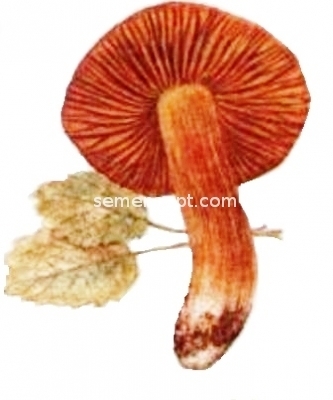
Cortinarius teddy, like other types of Cortinarius, before 1960 . considered harmless fungus . It was felt that among the huge number of Cortinarius (in Europe they grow more than 400 species) is only bitterinedible species and species relatively tasty, which are suitable for food . However, after frequent poisonings that occurred in Poland, many of which were fatal, it was found that the culprit was their Cortinarius teddy - smelling radish and mellow mushroom . In chemical analysis of his fruit was found several venomousconnections - Orellanine, Cortinarin, benzoin, etc. . Eating this and other types of Cortinarius particularly dangerous in that the first signs of poisoning may not appear immediately, but after a long time - from 3 to 24 days . Then comes the rapid deterioration the human condition, the kidneys, and death . Cortinarius teddy -relatively rare species . In some countries it still has not been found. In Europe, growing mainly in the autumn (sometimes in late summer) in deciduous, and occasionally in the coniferous forests . It forms mycorrhiza mainly with oak and birch . Most often occurs in acidic soils . Learn to recognize this extremely dangerous fungus is very difficult, t . k . there are many similar species; because of this, even for a specialist to determine Cortinarius teddy - no easy matter . All currently known venomous species of Cortinarius belong to the subgenus - Oegtosue . They differ slip, always dry fruit bodies, felt hat, silky and harmonious, not thickenedfoot . Plates painted in colors from orange to rusty - brown . Cortinarius orellanus hat is dry, dull, covered with small scales, having a diameter of 3 - 8.5 cm in early hemispherical, then flat, featureless with tubercle, orange or brown-red with gold shimmer . Plates rusty-red or brown . Legsizes 4-9 / 0.5 - 1.5 cm, dry, bottom rusty yellow, smooth, fine fiber . The pulp from light ocher to rusty-yellow . Taste of wishy-washy, weak odor-redisochny . Spore print rusty ocher . Spores yellow, 8,5-12 / 5.5 - 7 mm .
| SPECIFICATIONS | |
|---|---|
| Bag | |
| Form dispute | elliptical |
| The size of the dispute | 8.5 - 11 x 5,5 - 7.7 mm |
| Disputes | finely warty |
| Description | |
| Name in latin | Cortinarius orellanus \ Cortinarius rutilans |
| Rod | Cortinarius |
| Characteristics of the species | a solution of soda stain skin cap and stem black |
| Popular | a relatively rare species . In some countries, it still has not been found , |
| Symptoms | the first signs of poisoning appear not immediately, but after a long time - from 3 to 24 days . Then comes the rapid deterioration of the human condition,the kidneys, and death , |
| The fungus causes | causes a severe, sometimes fatal poisoning |
| Features | form mycorrhiza mainly with oak and birch . Most often occurs in acidic soils |
| Fruiting bodies are formed (grows) | autumn (sometimes in late summer) |
| Class | Agaricomycetes |
| Edible | dangerous poisonous mushroom |
| Distribution | in the Western Polesie |
| Grow | September - October |
| Smell | some smells radish |
| Fruiting body (Cap) | |
| Surface | thin, dark fiber, scaly |
| Color | red, orange-red, brick - brownish, darker in the center |
| Diameter | 3 - 8 cm |
| Form | blunt-cone-shaped, with the yellow Cortina subsequently convex-spreading, blunt hill in the center, with a lowered, fractured edge |
| Plant | |
| Flesh | in the header reddish - brown, yellow in the leg, a little smell radish |
| Plates | thin, wide, orange, then red-red |
| Features | spore mass rusty-brown |
| Features | to recognize this extremely dangerous fungus is very difficult, t . k . there are many similar species duethat even for a specialist to determine Cortinarius teddy |
| Stipe | |
| Diameter | 0.4 - 1.5 cm |
| Length | 3 - 9 cm |
| Color | golden yellow (or ocher), below reddish-brown, bare |
| Features | often to the base and tapers slightlyenters Tapered outgrowth dense |
Enter your information
To recover the password
Forgot password? Enter your e-mail
Registration for new users
Enter your details: