
-
- Notice
- No new notifications
-
- Messages
- See all notifications
-
18
- The cart
In the basket 0
in the amount of 0 RUB
- Go to basket
Vegetable seeds Flower seeds Grapes (plants) Mushrooms Agrochemicals
|
|
|
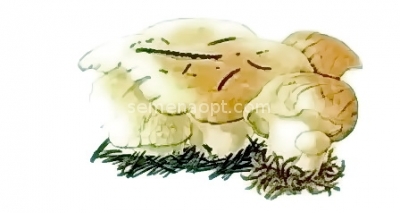
Among the six European species most often found Albatrellus fawn and Albatrellus sheep . They grow in coniferous forests prefer acidic soil and habitat in the foothills . Krasnoporku sheep (A . ovinus) can only be found under the fir trees, while krasnoporku yellow, forming a fused group, wesee under the various conifers . The best time for them to grow - summer and autumn . On krasnoporku like sheep and its close relative of A . subrubescens, growing under the pines and firs . It differs bitter taste . In deciduous forests, mostly in beech groves, we can meet krasnoporku comb A . cristatus with brownish-green orolive cap . All of the above types of krasnoporok edible, but because of the tough flesh poorly digested in the human body . A 1 shge 11 w OSCHPYB (3) has a whitish or yellowish, often cracked head diameter of 3 - 15 cm . Small tube white or yellowish, under pressure - yellow . Dimensions legs 2-8 / 1 - 4 cm, white . Flesh, toowhite, yellowing; Re drop of 804 stains in gray . pleasant taste, smell wishy-washy . Spores colorless, size 3.5-4.4 / 3 - 4 m .
| SPECIFICATIONS | |
|---|---|
| Bag | |
| Form dispute | round or ovoid |
| The size of the dispute | 3.5-4.4 / 3 - 4 pm |
| Disputes | colorless |
| Features | transparent, smooth, amyloid, often with large droplets of fat inside |
| Description | |
| Name in latin | Albatrellus ovinus |
| Rod | albatrellus |
| Features | forms clusters and groups are closely pressed against each other, sometimes coalesce legs and edges hats, fruit bodies |
| Fruiting bodies are formed (grows) | July to October |
| Class | Agaricomycetes |
| Edible | edible mushroom |
| Distribution | in the northerntemperate zone: marked in Europe, Asia, North America, is also found in Australia . In Russia: European part, Siberia and the Far East |
| Related species | like its close relative, and A . subrubescens, growing under the pine trees and spruce |
| Taste | with a pleasant taste |
| Grow | in coniferous forests prefer acidic soil and habitat in the foothills can be foundonly under the spruces |
| Smell | with expressionless smell |
| Fruiting body (Cap) | |
| Tubes | very short 1 - 2 mm long, angular pores or round, 2 - 5 1 mm |
| The kinks at the ends of branches | small tube white or yellowish, under pressure - Yellow |
| Surface | dry, bare,initially smooth, silky in appearance, then slightly scaly, cracked in old age (especially during dry periods) |
| Color | white, cream, light ocher, in adulthood grayish-yellow, light gray or brown, sometimes with bright yellow spots |
| Diameter | 3 - 15 cm |
| Form | round or somewhat irregular, initially convex withtucked edge, then flat or slightly concave, sometimes with a central cusp or uneven hilly |
| Features | the edge of the cap thin, sharp, sometimes pubescent, from gently undulating to paddle |
| Plant | |
| Flesh | white, yellowing, a drop of 804 Re stains in gray |
| Features | Species listed in the Red Book of Moscow Region |
| Stipe | |
| Diameter | 1 - 4 cm |
| Length | 2 - 8 cm , |
| Color | from the white (cream) to gray or light brown , |
| Features | a short, strong, smooth, solid, central or eccentric, narrowed to the base, sometimes slightly bent |
Enter your information
To recover the password
Forgot password? Enter your e-mail
Registration for new users
Enter your details: