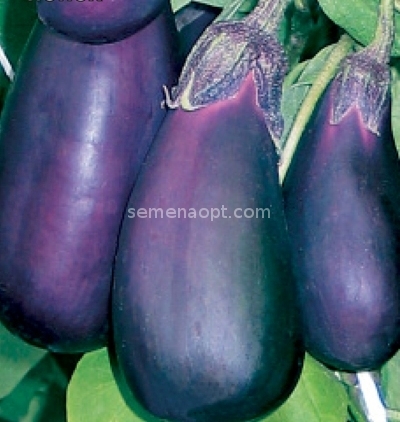
Robin Hood - yielding, very early variety, comes into bearing 90 - the 120th day of germination . bush a short, rare, spreading . The height of the bush
70 - 100 cm . Planting density - stretch 5 . / M 2 . The fruits of pear-shaped, purple, weighing 200 - 300 g size 16 - 21 × 8 - 9 cm, suitable for salting and pickling . Spikes weak . Averageyield in film greenhouses 7 - 12 kg / m 2 . unique varieties - fruit formation in all conditions, t . k . plants have high adaptive capacity . Designed for growing in greenhouses, outdoors, heated and spring unheated greenhouses .
unique varieties - fruit formation in all conditions, t . K . Plants have high adaptive capacity .
Maturation
early maturing
Growing area
Ukraine, Moldova, Russia
Purpose
for cooking and canning
Taste quality
other
Commercial quality
high ,
Resistance to diseases
tomajor diseases
Features farming
The period from germination to full maturity
90 - 120 days
Growing up
open (closed) primer / greenhouse
Seeding
on seedlings in early March in warm, moist soil in a greenhouse in late May-early June
Scheme sowing
60 - 65 cm between rows and 30 - 35 cm between plants in the row . 1 square . musually not more than precipitated 4 - 6 plants, t . k . Gelled landings leads to reduction of yield
Drilling depth
2 cm
Recommended thickness
heated greenhouses - 2.5 units . / sq. m in unheated greenhouses - 3 - 3.5 pc . / q . m
Harvest time (months . )
July, August
Recommended planting
best precursors melons, beans and green culture, and carrots .
For a description of the fetus
Color
lilac
Length (cm)
16 - 21 cm
Diameter
8 - 9 cm
Form
pear-shaped
Weight
200 - 300 g
Plant
Height (cm)
70 - 100 cm ,
Bush
a short,rare, spreading
Gardening
maintaining optimum temperature and humidity, feeding nitrogen and phosphate fertilizers, irrigation ,